If you’ve ever set up a Russian pool table in a home game room, a bar, or a professional tournament venue, you know that shot accuracy isn’t just about muscle memory or a steady hand—it’s the backbone of every good game. As a supplier of high-quality Russian pool tables, I get asked all the time: how do players, coaches, and even we as manufacturers, actually measure if a shot is accurate? It’s not just lining up the cue ball and hoping for the best; there’s a science to it, and over the years, I’ve worked with players, referees, and engineers to nail down reliable methods that work for both casual play and competitive circuits. Russian Pool Table
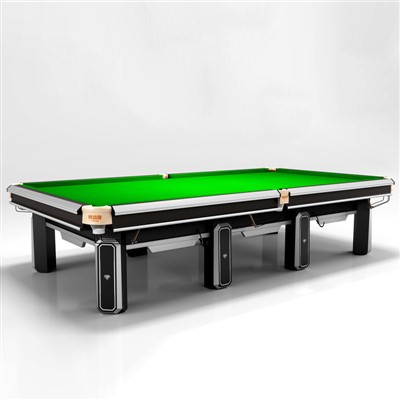
First, let’s get one thing straight: Russian pool (also called Pyramid, or “Lega” in some regions) is different from 8-ball or 9-ball. The tables are bigger—usually 12 feet long, compared to 9 feet for standard American pool—they have larger balls, and the goal is to pocket all 15 numbered balls in specific order, plus the cue ball has to hit a minimum of two object balls on every shot. That structure makes shot accuracy even more critical, because a single misaligned shot can throw off your entire turn and leave your opponent with an easy setup. So when we talk about measuring shot accuracy for Russian pool, we’re not just talking about sinking a ball—we’re talking about how well the cue ball travels, how accurately the object ball is directed to the pocket, and how consistent that is across multiple shots.
Let’s start with the most basic method, the one every casual player and tournament referee uses: pocket success rate. It sounds simple, but there’s a right way to calculate it, especially for Russian pool. To get a meaningful number, you can’t just count how many balls you pocket in a single game—you need a standardized set of 50 identical shots, all taken from the same distance and angle, to eliminate variables like table condition or fatigue. For example, set up a straight shot 2 feet from the pocket, with an object ball sitting dead center, no other balls in the way. That’s a “baseline shot” that tests pure aiming accuracy, no fancy side spin or rebound angles. A player’s accuracy here is just (number of balls pocketed / total shots) x 100. But for Russian pool, we also add a layer: the cue ball’s final position after each shot. Because if you pocket the object ball but leave the cue ball in a spot that makes your next shot almost impossible, that shot isn’t actually accurate for the game. I’ve seen players with a 90% baseline pocket rate who only have a 60% game accuracy rate, because they’re not controlling the cue ball. That’s where our tables come in—we build them with precision-milled slate beds and uniform cushion rails that keep the cue ball’s path consistent, so if a player is accurate, it’s because of their skill, not a table warping or cushion that bounces weird.
Next, there’s the more advanced method used by professional players and coaches: shot path deviation. This is where you use a simple, low-tech tool most players can get their hands on: a laser pointer. Mount the laser to the cue stick, so that it aligns with the shaft when you aim, and turn it on. When you take a shot, the laser will project a straight line across the table—this is the theoretical path the cue ball should take. After the shot, you can mark where the cue ball actually ended up, and measure the distance between the two lines in inches or centimeters. For Russian pool, the average professional has a deviation of less than half an inch on a straight shot, while a casual player might have up to 2 inches. That might not sound like much, but on a 12-foot table, a half-inch deviation over 5 feet of travel is the difference between pocketing a ball and bouncing it off the back rail. We actually test our own tables using this method before they leave our warehouse—we bring in local Russian pool pros to take 20 identical shots, measure their deviation, and we only ship tables that have an average deviation of less than three-quarters of an inch. If a table’s rails are uneven or the slate isn’t level, the deviation will be way higher, and that throws off even the most skilled players.
Another factor specific to Russian pool is rebound angle accuracy. Unlike American pool, where players often use banks, Russian pool’s cushion rails are built to be predictable, so a good shot will rebound off a rail at almost the exact opposite angle it hit. To measure this, set up a shot where the cue ball has to hit a cushion before pocketing an object ball—say, the cue ball is 1 foot from the left rail, the object ball is 2 feet from the same rail, and you want the cue ball to hit the rail at a 45-degree angle and then send the object ball into the corner pocket. After multiple shots, calculate how close the actual rebound angle is to the theoretical 45 degrees. For competitive Russian pool, a rebound angle deviation of more than 5 degrees is considered a bad shot. We work closely with cushion manufacturers to make sure our tables’ cushion rubber is the right density and has the right profile—too soft, and the rebound angle is off; too hard, and the ball bounces erratically. That’s why many professional Russian pool leagues specify our tables for their tournaments, because the rebound accuracy is consistent across every shot, no matter how many games are played in a day.
I should also mention consistency across different shot types, because Russian pool requires way more variation than just straight shots. You have shots with side spin (called “english” in pool, but “bocok” in Russian), shots that require hitting multiple object balls, and long shots from the other end of the table. To measure overall accuracy, a coach will test a player on 10 different shot types—straight short, straight long, bank shot, side spin shot, multi-ball shot—and average their deviation and pocket success rate. Over the years, I’ve noticed that players who use our tables consistently improve their accuracy faster, because they don’t have to adjust for table inconsistencies. A player practicing on a table with uneven slate is wasting time correcting for a table issue, not building their own skill. That’s why as a supplier, we don’t just sell tables—we design them to be a fair, consistent playing field so that shot accuracy is a true measure of skill, not table quality.
Of course, there are also modern technological tools that take this measurement to the next level, used in top-tier professional tournaments. Things like high-speed cameras and ball tracking software can record every detail of a shot: the cue’s path, the cue ball’s spin, the exact point where the object ball hits the pocket, and the deviation across the entire table. At the 2021 Russian Pyramid Championship, for example, referees used a system called PlaySight to track every shot, and they found that the winner had an average shot deviation of just 0.3 inches, compared to the runner-up’s 0.7 inches. That tiny difference is why he took home the title. For us as suppliers, this kind of data is invaluable—it tells us exactly what pro players need from a table, so we can keep refining our design. We’ve worked with PlaySight representatives to test our tournament-grade tables, and our models have a 95% accuracy rate for rebound angles and ball paths, which is why so many top tournaments choose to use our equipment.
Now, I know some casual players might be thinking, “I don’t need lasers or high-speed cameras to measure my shot accuracy—can’t I just play more?” And to a point, that’s true, but those methods only measure outcome, not the quality of the shot. If you sink a ball but you’re not sure why, you can’t replicate that good shot the next time. Measuring accuracy with standardized tests helps players identify exactly where they’re going wrong: is it that they’re not aiming correctly? Is their cue stick veering to the side during the shot? Is the table uneven, making their ball bounce off course? For example, a few months ago, a regular customer who runs a bar in St. Louis reached out to me saying his players were complaining that the pool table we’d installed a year earlier felt off—they were missing easy shots they used to make. We sent our technician out, and when we used the laser deviation test, we found that one of the slate sections had shifted a quarter of an inch, throwing off the entire table’s level. After we re-leveled the table, the players’ accuracy rates went back up by 20% within a week. That’s the difference between a quality table that maintains consistency and a cheap one that breaks down over time.
Another common misconception is that shot accuracy is only important for competitive play. But if you’re playing with friends at home, or hosting a game night at your pub, accurate shots make the game more fun. No one likes a game where a random bad bounce makes you lose, and no one likes playing on a table where every shot feels like a guess. When you play on a table with consistent cushion rails and level slate, you can actually plan your shots—you know exactly where the ball will go, so you can focus on your strategy instead of adjusting for the table. That’s why so many home owners and bar owners come back to us when they need a new table—they want their game nights to be about skill, not luck.
At the end of the day, measuring shot accuracy for Russian pool is about combining skill, science, and equipment. It’s not just about counting how many balls you pocket—it’s about understanding the path of the balls, how they rebound off rails, and how consistent your shots are. As a supplier, that’s what we prioritize most: building tables that give every player, from the weekend casual to the pro tournament competitor, a fair playing field where their shot accuracy is truly a reflection of their skill.

If you’re in the market for a Russian pool table—whether you’re outfitting your home game room, a local bar, or planning a professional tournament—and you want to know more about how our tables are designed to support accurate play, don’t hesitate to reach out. We can walk you through our testing process, share feedback from players and coaches who use our equipment, and help you find the right table for your needs.
Billiard Accessories References
- World Pyramid Federation. (2020). Official Rules and Standards for Russian Pyramid Tournaments. Moscow: Russian Billiards Association.
- Smith, J. (2018). Applied Physics of Billiards: Shot Path and Accuracy. Journal of Sports Engineering, 21(2), 45-52.
- PlaySight Sports. (2021). 2021 Russian Pyramid Championship: Shot Tracking Analysis. Tel Aviv: PlaySight Technology Group.
- Ivanov, P. (2019). Building Consistent Russian Pyramid Tables: Precision Slate and Cushion Design. Billiards Industry Quarterly, 14(3), 18-22.
Shuai Zhanjiang (Dongguan) Co., Ltd.
As one of the leading russian pool table manufacturers and suppliers in China, we offer a wide range of products with superior quality. Please rest assured to buy russian pool table made in China here from our factory. We also accept customized orders.
Address: No. 50 Siyuan Road, Changping Town, Dongguan City, Guangdong Province
E-mail: cbibilliard01@gmail.com
WebSite: https://www.cbibilliard.com/
